Multi-Model vs Single-Model AI Coding Agents: We Put Four Agents to the Test
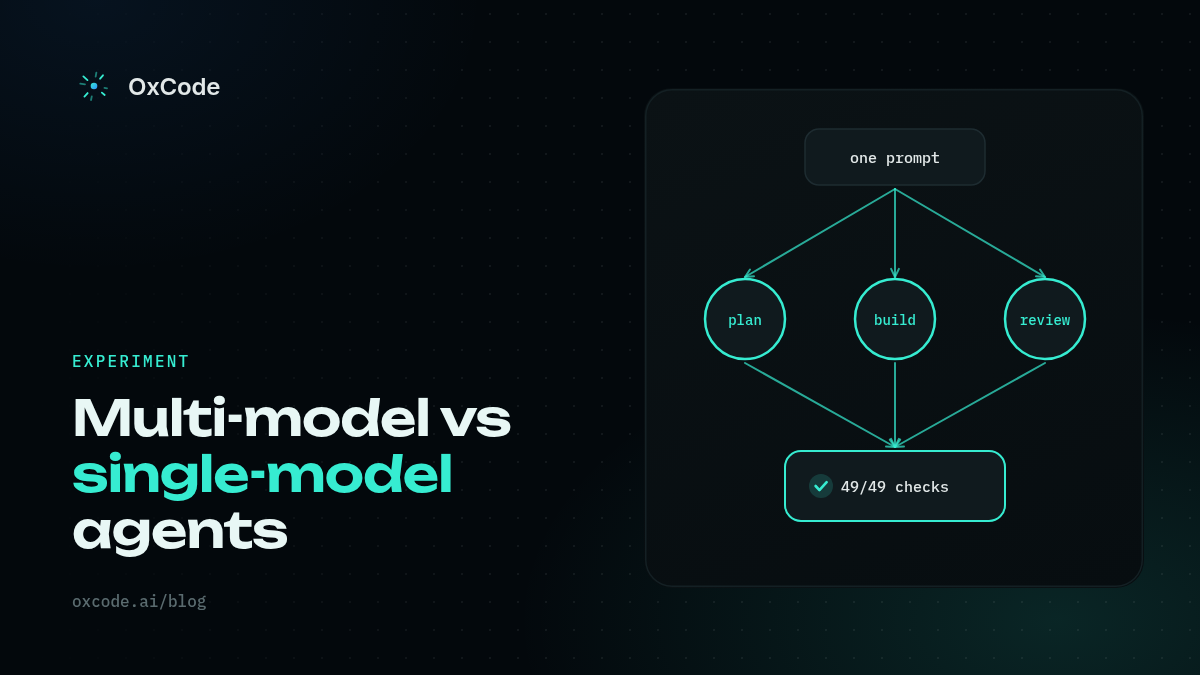
Does an AI coding agent need the most powerful model for every engineering task? Or can a carefully orchestrated combination of models produce better results?
This is a question we've been exploring while building OxCode.
Most discussions around AI coding agents eventually come down to the underlying model. Developers want to know whether an agent uses Claude, GPT, Gemini or something else, and understandably, they often gravitate towards the most capable model available.
But software engineering involves several different kinds of work. Planning an architecture, implementing a feature, debugging an error and reviewing code aren't necessarily problems that require the same model.
What happens when we separate those responsibilities?
We tested four AI coding agents on the same application to find out.
The experiment
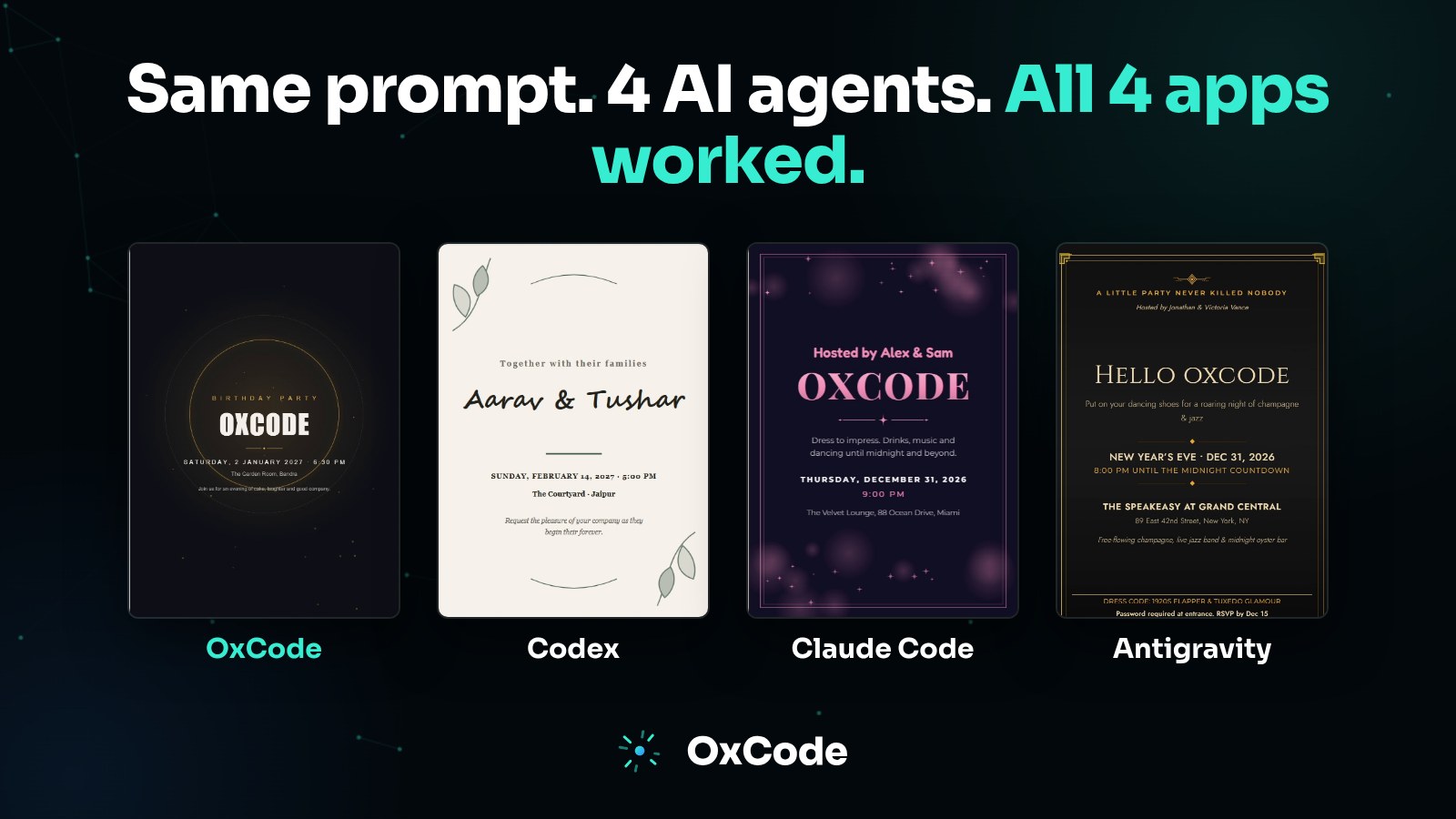
We gave OxCode, Claude Code, Codex and Antigravity the same prompt: build a beautiful, simple, mobile-friendly Invitation Card Maker with Birthday, Wedding, Anniversary and Party templates, a live editor and PNG downloads.
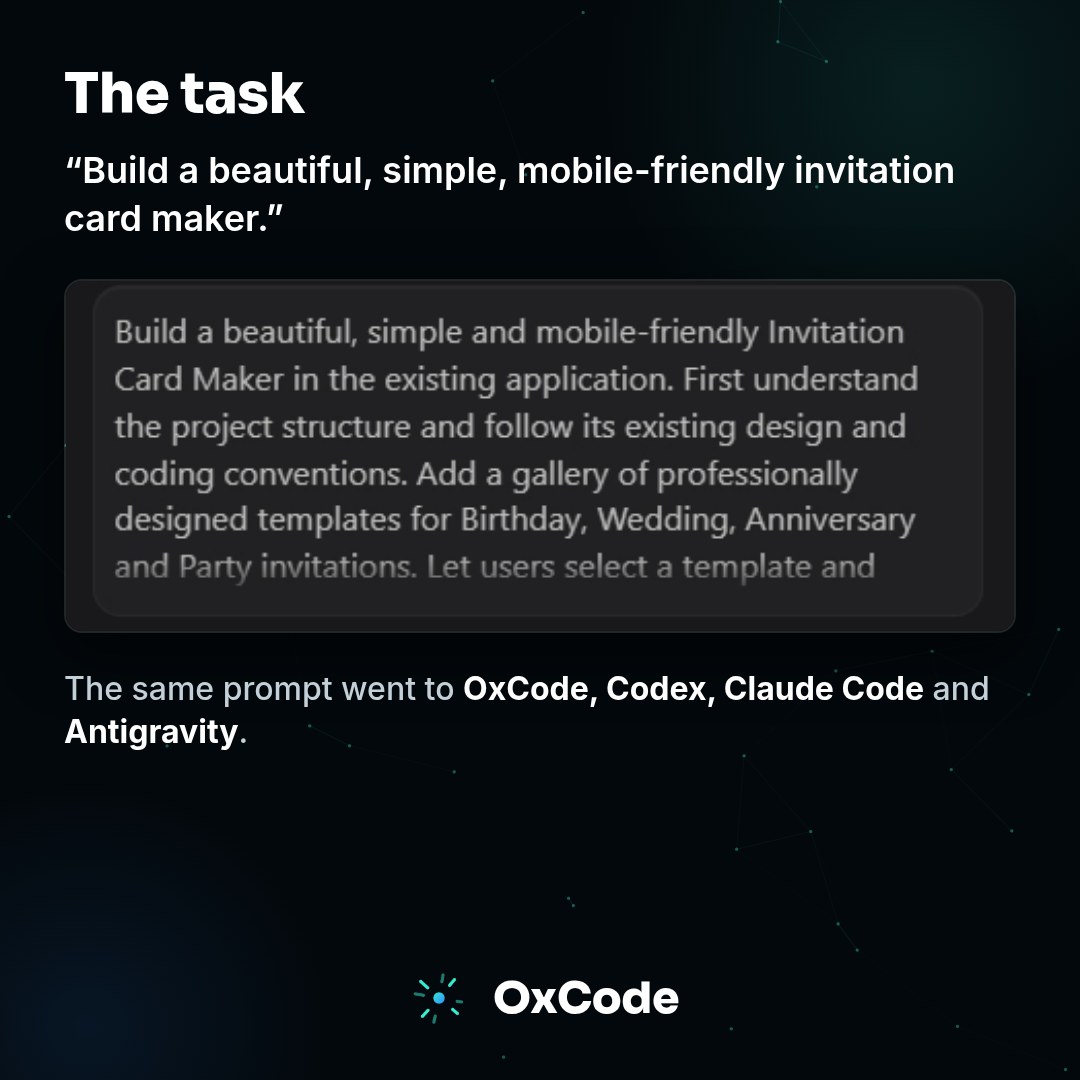
The main difference was how the agents used their underlying AI models.
| Agent | Model configuration |
|---|---|
| OxCode | Claude Opus 4.6 for planning, DeepSeek V4 Pro for execution and Kimi K2.7 Code for review |
| Codex | GPT-5.6 Sol |
| Claude Code | Claude Opus 5.5 |
| Antigravity | Gemini 3.8 Flash |
The other agents were configured with a single selected model, while OxCode distributed engineering responsibilities across three models.
We wanted to see whether this approach could compete with agents configured to use powerful individual models, and where the differences would show up in the finished software.
Why we distribute engineering work across multiple models
An experienced software engineer doesn't approach every part of a project in the same way.
Designing an architecture requires a different kind of thinking from implementing a form component. Debugging a rendering issue is different from reviewing a completed implementation.
Yet we often expect a single AI model to handle all of these responsibilities within the same workflow.
With OxCode, we're taking a different approach.
For this experiment, Claude Opus 4.6 handled planning and architectural reasoning, DeepSeek V4 Pro handled implementation and iterative execution, and Kimi K2.7 Code was assigned the review role.
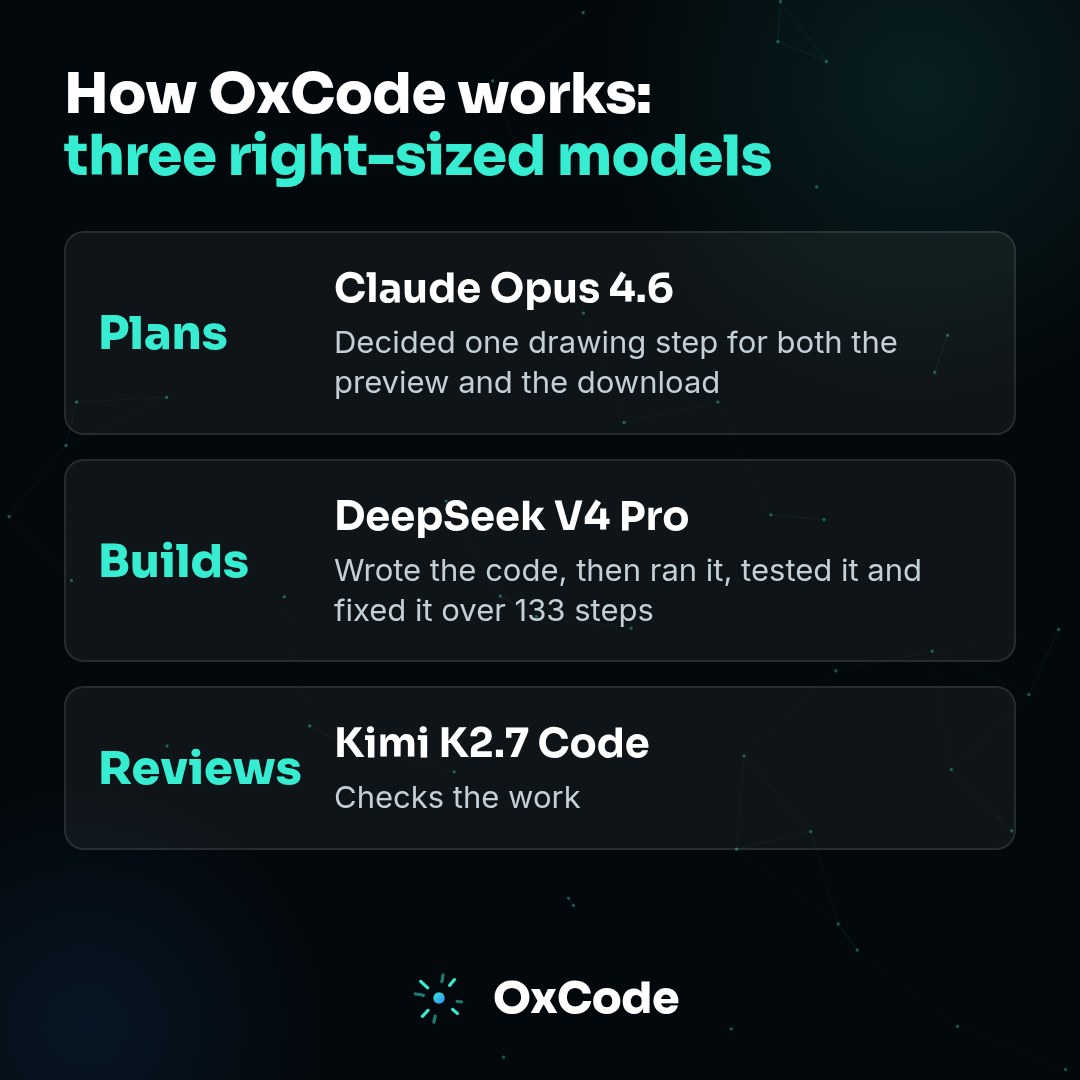
The idea isn't simply to combine multiple models and hope for better results. It's to assign responsibility according to what each model is suited for, while maintaining continuity across the engineering workflow.
The interesting question is whether that separation translates into a better outcome.
All four agents built a working application
Every agent successfully produced a functioning invitation card maker.
That's worth acknowledging. All four delivered the core functionality requested in the prompt, although their implementations differed in design, dependencies and verification.
| Feature | OxCode | Codex | Claude Code | Antigravity |
|---|---|---|---|---|
| Template designs | 12 | 8 | 8 | 15 |
| Installation required | No | No | No | npm install |
| Chats to completion | 1 | 1 | 1 | 4 |
| Browser testing | 49 checks | Unavailable | 24 checks | Browser test agent |
| Reusable tests retained | Yes, 49/49 passing | No | No | No |
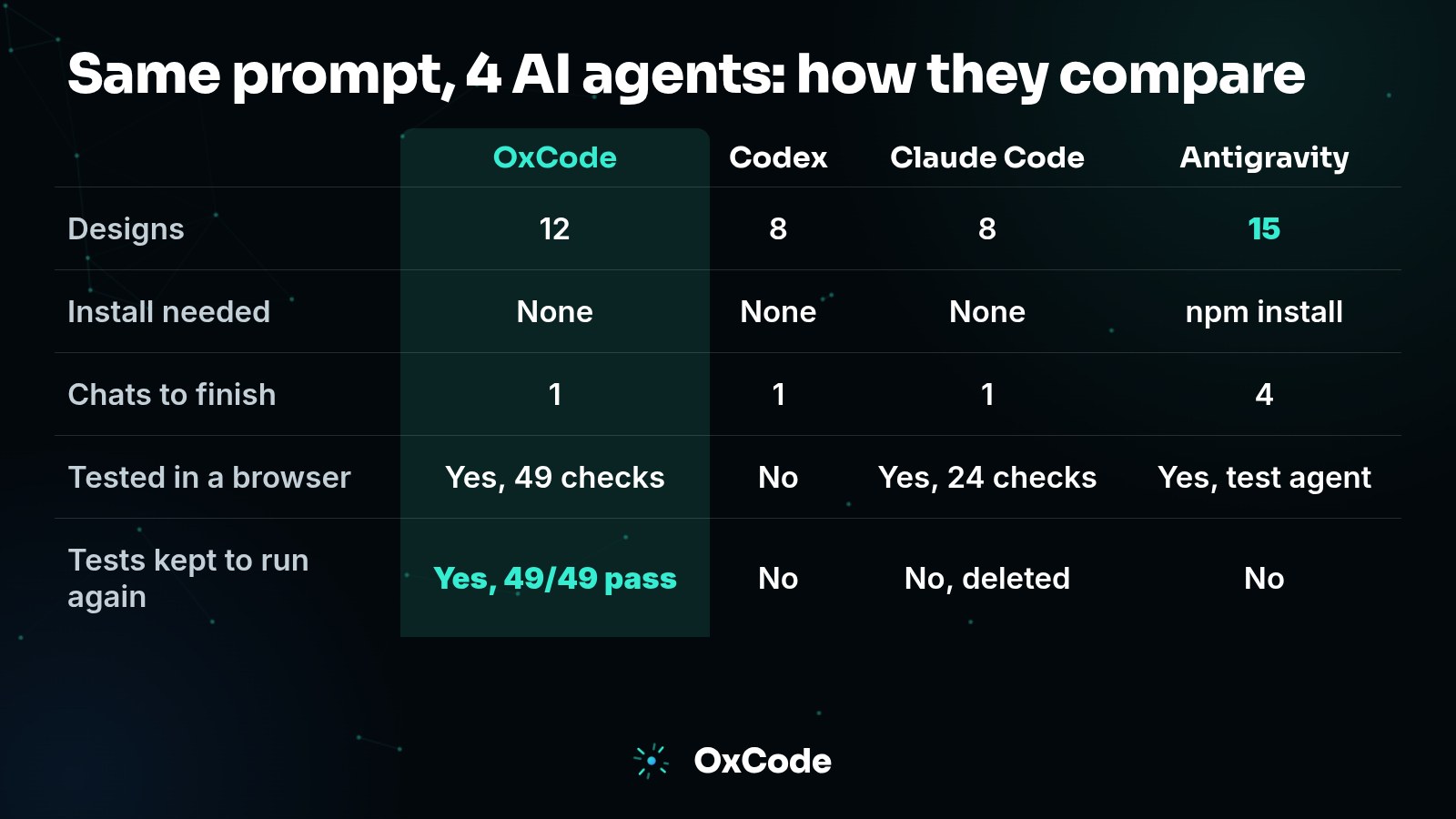
Antigravity produced the largest selection of designs and offered extensive styling options. Claude Code completed the task quickly and performed thorough browser testing. Codex delivered a clean, dependency-free implementation in a single chat.
OxCode's most interesting results came from how its planning, implementation and verification stages worked together.
Where multi-model orchestration made a difference
Planning decisions carried through to implementation
One of the key decisions made during OxCode's planning stage was to use the same rendering function for both the live invitation preview and the downloaded PNG.
This might seem like a small architectural decision, but it matters.
If the preview and export use separate rendering implementations, differences in positioning, fonts, scaling or colours can easily creep in. The downloaded invitation may look different from what the user designed.
By using a shared renderer, OxCode avoided maintaining two independent rendering paths.
The executor then implemented the design and compared the generated images pixel by pixel.
The average difference was just 0.22 intensity levels per colour channel on a scale of 0 to 255.
Claude Code took a similar approach and reported an average difference of approximately one level.
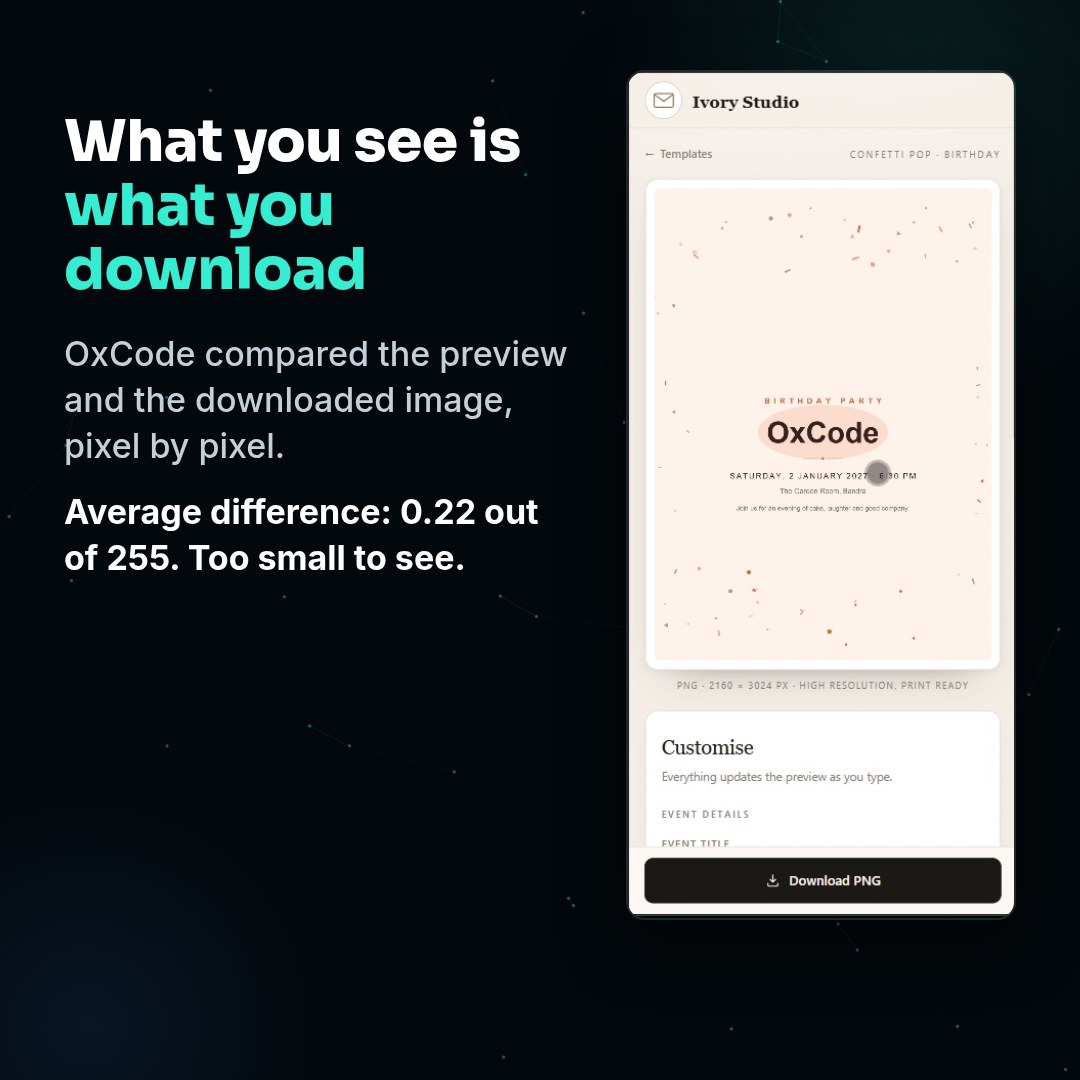
What interested us here was seeing an architectural decision made during planning carry through into implementation and measurable verification.
Implementation included an iterative testing and debugging cycle
DeepSeek V4 Pro handled the execution stage, working through 133 steps that included implementation, testing and debugging.
During this process, OxCode discovered three issues:
- A layout calculation returned
NaN, preventing invitation elements from rendering correctly. - A form element overflowed its container on mobile devices.
- A button nested inside a label unintentionally triggered the colour picker.
These issues were identified and fixed before the application was handed over.
Claude Code also reported identifying and fixing three problems during its testing process.
That reinforces an important point: a capable single-model agent can also perform effective verification. Multi-model orchestration is interesting because it offers another way to organise and execute that work.
The verification survived the handover
OxCode generated 49 automated browser checks covering the template gallery, filters, editor controls, responsive layouts, image downloads and console errors.
It retained the test suite within the project.
We ran it again ourselves. All 49 checks passed.
Claude Code reported completing 24 automated browser checks but removed its temporary testing setup afterwards. Antigravity used a browser testing agent, while Codex reported that browser testing wasn't available in its environment.
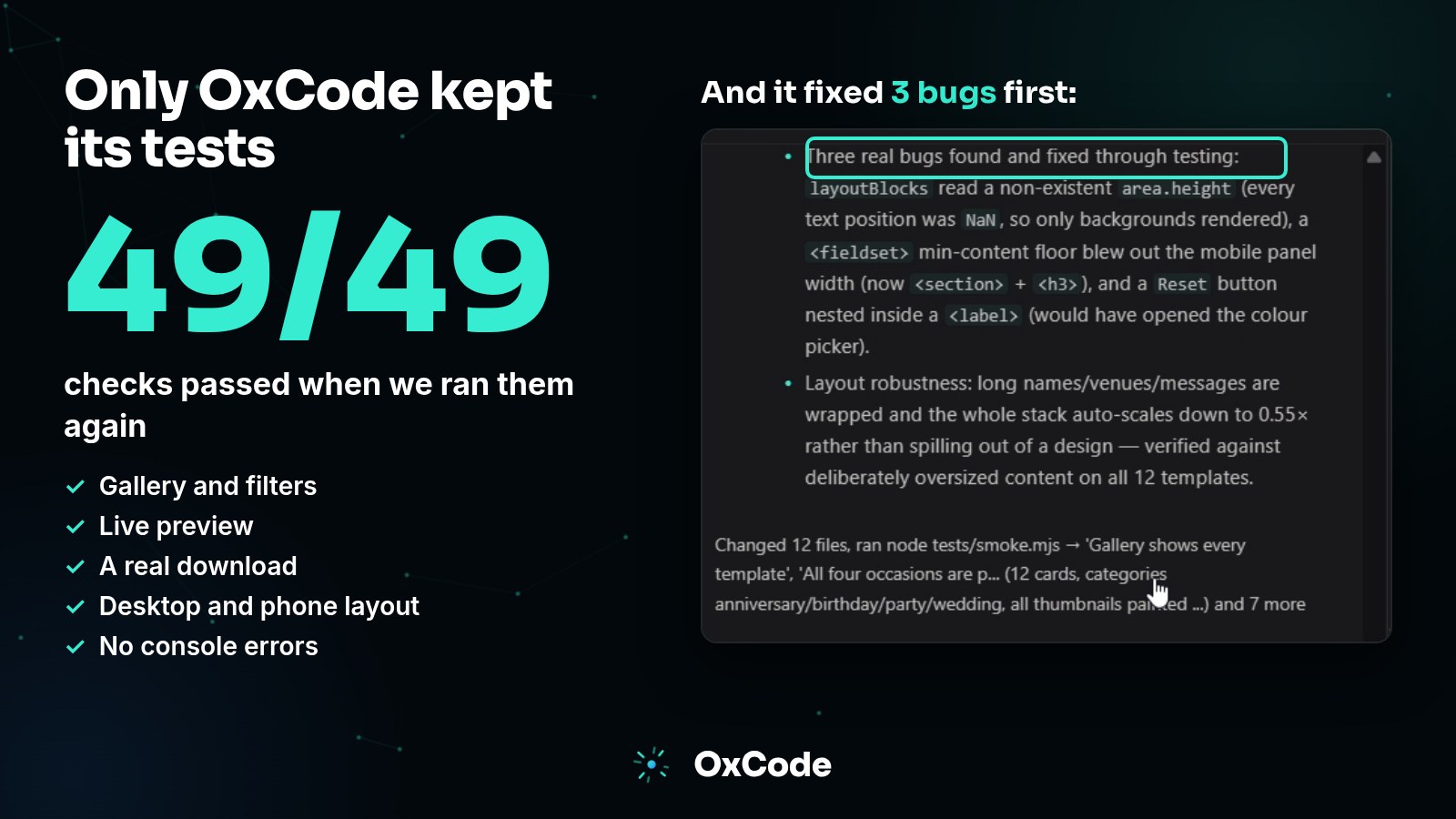
Leaving the tests behind is particularly useful from a software engineering perspective. The next developer can modify the application and immediately check whether existing functionality still works.
OxCode also included a README, a font regeneration script and project memory documenting the architectural decisions and issues encountered during implementation.
Does using multiple models mean using fewer tokens?
Not necessarily, and this experiment is a good example.
OxCode consumed approximately 19.3 million tokens, considerably more than the other agents. Around 94% of its input tokens were cached.
Antigravity consumed approximately 5.4 million tokens across four chats, while Codex and Claude Code used considerably fewer tokens than OxCode.
The additional consumption in OxCode's workflow largely came from its extended implementation, testing and debugging cycle.
This is a trade-off worth understanding. Multi-model orchestration doesn't automatically make an agent more token-efficient. Model pricing, caching, execution time and the amount of verification performed all affect the economics of the task.
We didn't calculate comparable execution costs in this experiment, so token consumption alone doesn't establish which approach was cheaper.
The more useful question is whether the additional computational work produced an outcome that justified it.
Can multi-model AI coding agents outperform single-model agents?
In this experiment, OxCode's multi-model configuration delivered a competitive application and the most extensive reusable automated verification of the four agents.
It didn't need to rely on the newest frontier model for every part of the workflow. Instead, it distributed planning, implementation and review responsibilities across different models.
However, the results also highlight that different agent architectures have different strengths.
Claude Code demonstrated strong testing capabilities with a single selected model. Codex produced a straightforward implementation with relatively low token consumption. Antigravity delivered the widest selection of designs.
What this experiment suggests is that access to a powerful model isn't the only factor determining how useful an AI coding agent can be. How the agent coordinates planning, execution, debugging and verification matters too.
That's the direction we're pursuing with OxCode, an AI software engineer.
Rather than making developers constantly decide which model to use, we're building an agent that can distribute engineering work across models and take responsibility for the overall result.
As foundation models continue improving, we believe intelligent model orchestration will become an increasingly important part of building capable AI coding agents.
The strongest model available today may not be the strongest model tomorrow. An effective engineering system should be able to benefit from those improvements without being fundamentally dependent on any one model.
Experiment methodology: All four agents received the same prompt, with one task attempt per agent, recorded on 19 November 2026. Antigravity required four chats during its attempt. We reviewed the generated source code, independently re-ran OxCode's test suite and confirmed that Antigravity's production build compiled. Token figures were obtained from the respective usage reports.
This is a comparison of four complete agent configurations on one engineering task, rather than a controlled benchmark isolating model orchestration alone.